
Contempora Bass Trombones
Foster Reynolds made trombones from the beginning of operations in his factory, a reflection of his familiarity with the instrument from decades of work on King trombones at H.N. White. However, he appears to have only made straight tenor trombone models in his brief time at his own company. Reynolds trombones with triggers and F attachments, valve trombones and bass trombones were evidently not produced until the late 1940s and 1950s, under the guidance and ownership of Scherl & Roth.
Ironically, one of the biggest names in mid-century band instruments, Foster Reynolds, worked for two of the biggest names in American trombone design and manufacturing—H.N. White and F.E. Olds—but the trombone that the Reynolds company is most known for was developed under a different hand.
World War II
Reynolds produced instruments for U.S. Army Air Force service bands throughout the 1940s. These instruments have a silverplate finish with a different engraving style from Reynolds' standard models and a large "U.S." mark engraved by the bell rim.
F.A. Reynolds Bass Trombone with USAAF military engraving and silverplate finish (c.1948-49)
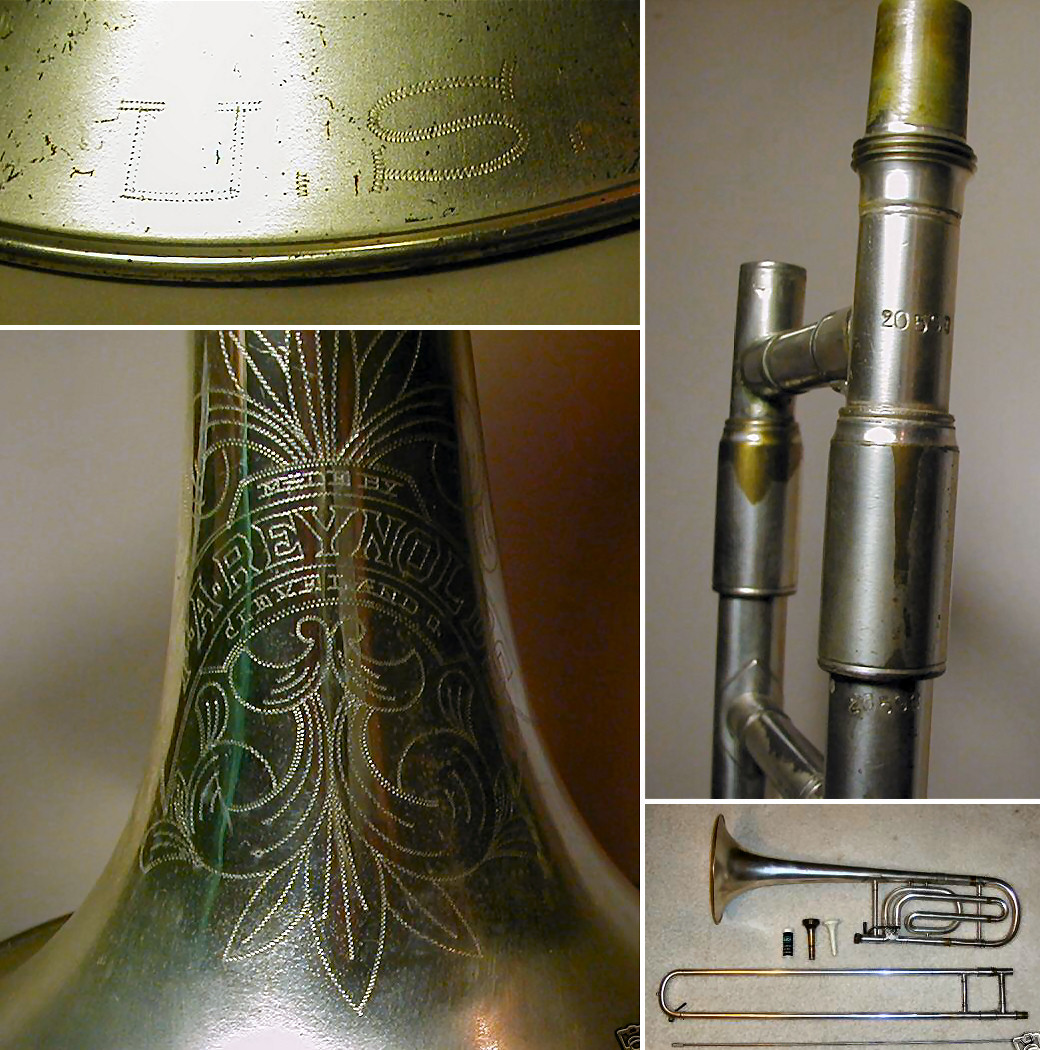
F.A. Reynolds Bass Trombone [SN 20598, c.1948-49]. Photo source: eBay.
F.A. Reynolds Bass Trombone with USAAF military engraving and silverplate finish (c.1949)
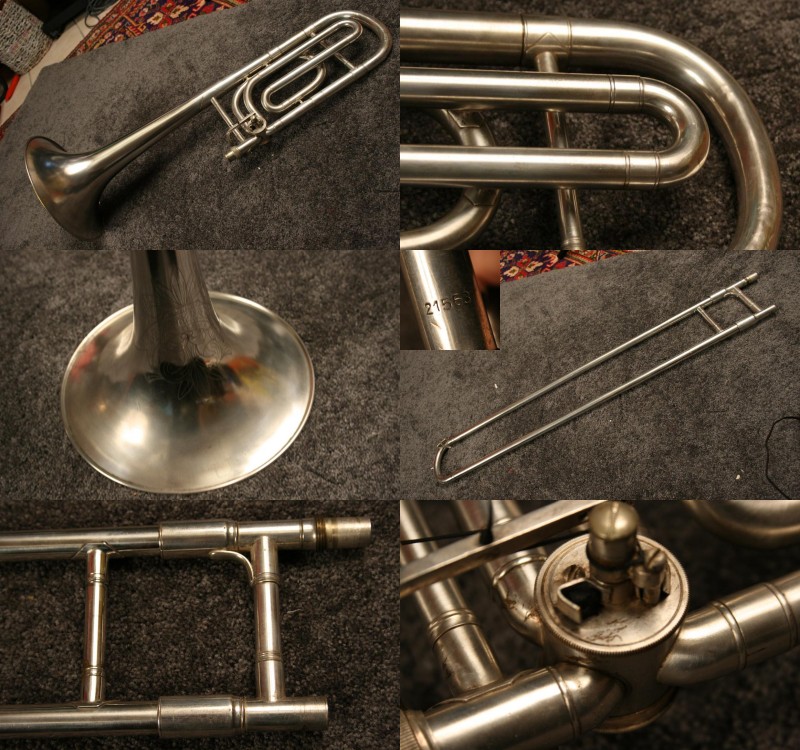
F.A. Reynolds Bass Trombone [SN 21563, c.1949]. Photo source: eBay.
F.A. Reynolds Bass Trombone with USAAF military engraving and silverplate finish (c.1951)
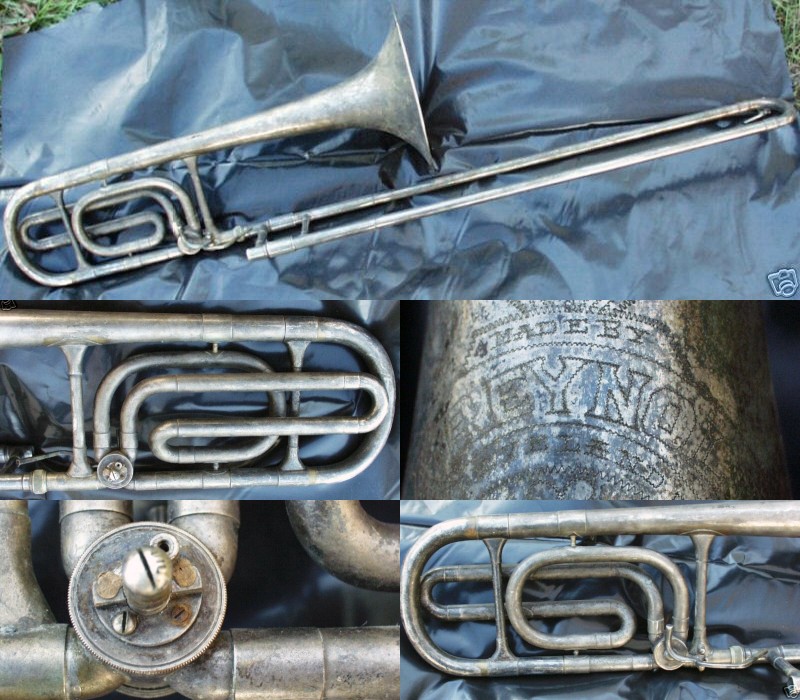
F.A. Reynolds Bass Trombone [SN 27978, c.1951]. Photos used with permission from eBay Member: misterhiggins13.
c.1949-1952
F.A. Reynolds, division of Scherl & Roth (Cleveland, Ohio)
The bass trombone was evidently one of two new instruments introduced c.1949 to launch the new "Contempora" model line (along with the trumpet). The corresponding catalog description includes this line: "Reynolds has long been conscious of the need for a new and better bass trombone, but would never approve its manufacture until...", suggesting that Contempora represented the company's first and long-awaited step in making a bass trombone.
However, the first two USAAF models shown above have features that predate c.1949—specifically the ferrules used on the bell and slide braces (see design note below). It's not known if these military instruments were uniquely made as part of a government contract and served to proof out the design before Contempora launched, or if they represented an earlier version that needed to be improved.
A few things stand out in the example photo below: the minimal amount of bracing used on the F attachment tubing, the lack of a slide lock, the conventional brass bell, and the older vertical "F.A. Reynolds" monogram-style (faint) engraving. The characteristic bronze-alloy bell and "Contempora" engraving would come later.
Design Note
In c.1949, Reynolds redesigned the bell and slide bracing used on their trombones. The new braces resemble those used by F.E. Olds, though they are made with separate post and ferrule components, not Olds' patented one-piece design. This allowed brass and nickel-silver components to be mixed or matched on different models.

(l) Olds one-piece brace; (r) Reynolds three-piece brace
Reynolds trombones with serial numbers after 22000 have the new brace style. As with the Emperor's nickel-silver bell flare and the Contempora's bronze-alloy bell, it is unknown if the resemblance to an Olds design feature was coincidence, competition or collaboration with founder Foster Reynolds, then working at F.E. Olds.
Model 72
F.A. Reynolds Contempora Bass Trombone
Bore: .564"
Bell: 9½"
Materials: brass bell, main tuning crook and gooseneck; nickel-silver bracing and trim, outside slide tubes and slide receiver
Valve: rotary valve with closed-wrap F attachment and E slide; brass with nickel-silver outer slide tubes
Slide: brass outer slides with nickel-silver sleeves; chrome-plated nickel silver inner slide tubes; chrome-plated hand grips
Finish: polished brass with clear lacquer finish

Contempora Bass Trombone, Model 72 [SN 22236, c.1950]. Photo source: eBay.
The new and majestic Reynolds Contempora - Supreme potentate of modern bass trombones
Reynolds has long been conscious of the need for a new and better bass trombone, but would never approve its manufacture until absolutely certain the instrument would deliver everything the most exacting bass trombonist would ever want.
This is it!—a big, round, robust tone, wonderful balance, lightning-like slide action, and instant tonal response—from the deepest pedal tones to the flexible upper limits of the instrument.
1952-1961
Roth-Reynolds (Cleveland, Ohio)
Technical developments on the Contempora bass trombone evolved rapidly in the 1950s, with the primary goal being more accurate playing of low register notes, especially chromatics and pedal tones. Review the model details here, then see "The Stereophonic Story" for a more detailed narrative of these changes.
The bass trombone's version of the bronze-alloy bell was introduced by c.1953—see the model notes below for comments. The Reynolds single-valve bass trombones have a characteristic lighter sound with plenty of bite that makes it attractive for big band and other settings where today's broad, dark orchestral sound is not desired.
The Contempora Bass Trombone possesses a sonorous, penetrating bass tone quality throughout its full range. The Contempora is the majestic leader of all Bass trombones. Equipped with rotary change to F and E slide for perfect intonation in low pedal tones. Contempora features Bronz-o-lyte bell, nickel silver trim and fine slide action built for a lifetime of accurate and dependable service. Correctly balanced to insure tireless playing. Equipped with two mouthpieces, scientifically developed and designed, and endorsed by prominent Symphony players.
Model 72
Reynolds "Symphony" Contempora Bass Trombone
Bore: .564"
Bell: 9½" (10" option in 1959)
Materials: bronze-alloy bell; brass main tuning crook and gooseneck; nickel-silver bracing and trim, outside slide tubes and slide receiver
Valve: rotary valve with closed-wrap F attachment and E slide; brass with nickel-silver outer slide tubes
Slide: brass outer slides with nickel-silver sleeves; chrome-plated nickel silver inner slide tubes; chrome-plated hand grips
Finish: polished brass with clear lacquer finish
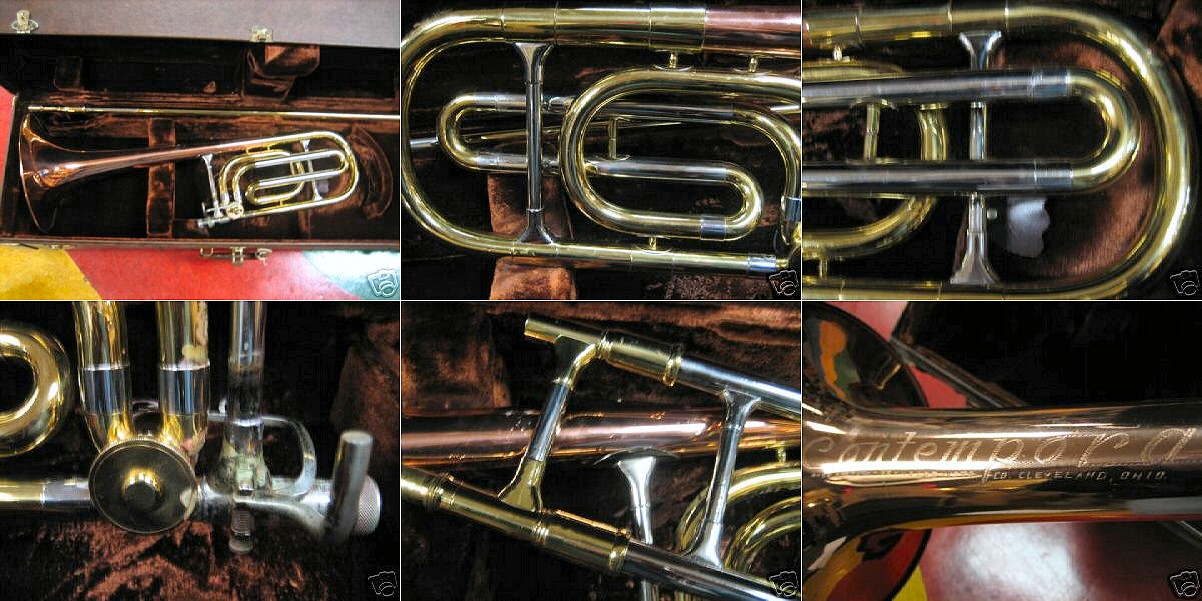
Contempora Bass Trombone, Model 72 [SN 50324, c.1958]. Photo source: eBay.
Model Note
The color of the bass trombone's "Bronz-o-lyte" bell is much darker than Contempora trumpets, cornets and tenor trombones, and, depending on wear, can be almost orange in appearance compared to the golden smaller horns, which led to the Contempora bass trombones earning the nickname, "the Tangerine Trombone."
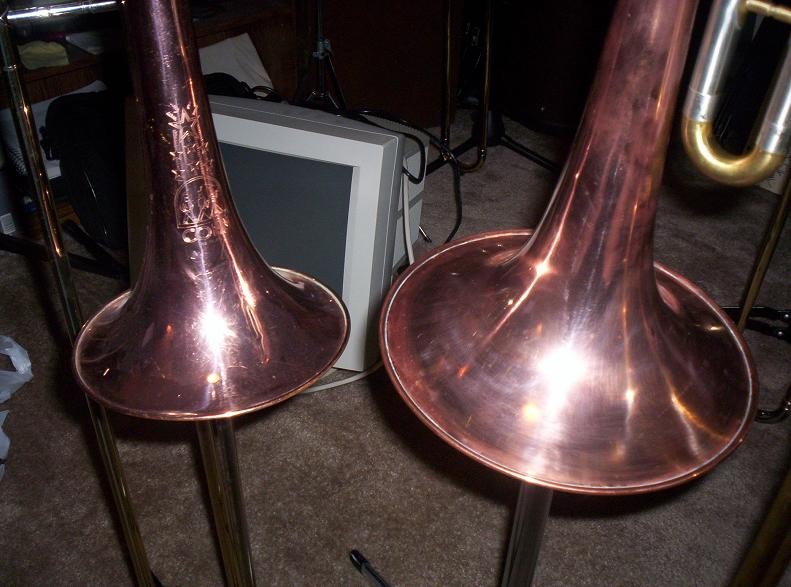
Bells that have been stripped of lacquer have a deeper purple color, very similar to a Conn Coprion bell, which was made of 100% copper. Bells from the smaller instruments are more pink in color when stripped to the raw metal. It's not known if the bass trombone bell was made of a different metal alloy.
Here is a Conn Coprion bell (left) and a stripped c.1958 Contempora bass bell (right):
Model 72-X
Reynolds "Philharmonic" Contempora Bass Trombone (introduced c.1955-56)
Bore: .564"
Bell: 9½" or 10"
Materials: bronze-alloy bell; brass main tuning crook and gooseneck; nickel-silver bracing and trim, outside slide tubes and slide receiver
Valve: rotary valve with closed-wrap F attachment; second tuning slide to E; brass with nickel-silver outer slide tubes
Slide: brass outer slides with nickel-silver sleeves; chrome-plated nickel silver inner slide tubes; chrome-plated hand grips
Finish: polished brass with clear lacquer finish
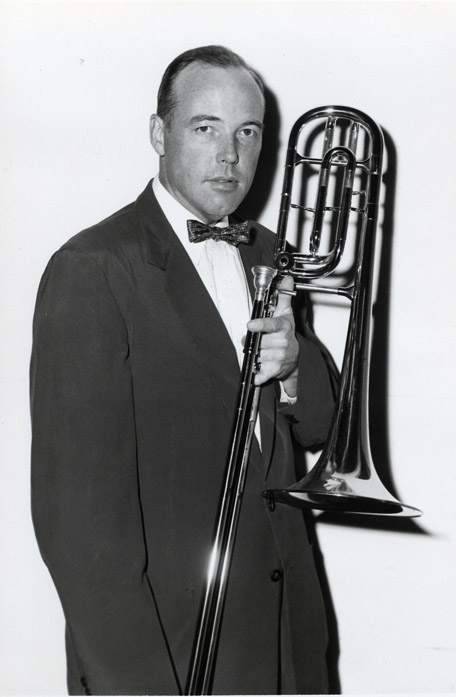
Kauko Kahila, Boston Symphony Orchestra, with Contempora Bass Trombone, Philharmonic Model [c.1955-56].
Model 78-X
Reynolds "Stereophonic" Contempora Double-Valve Bass Trombone (introduced 1958)
Bore: .564"
Bell: 10"
Materials: bronze-alloy bell; brass main tuning crook and gooseneck; nickel-silver bracing and trim, outside slide tubes and slide receiver
Valve: two rotary valves with dependent F/flat E attachments; brass with nickel-silver outer slide tubes
Slide: brass outer slides with nickel-silver sleeves; chrome-plated nickel silver inner slide tubes; chrome-plated hand grips
Finish: polished brass with clear lacquer finish
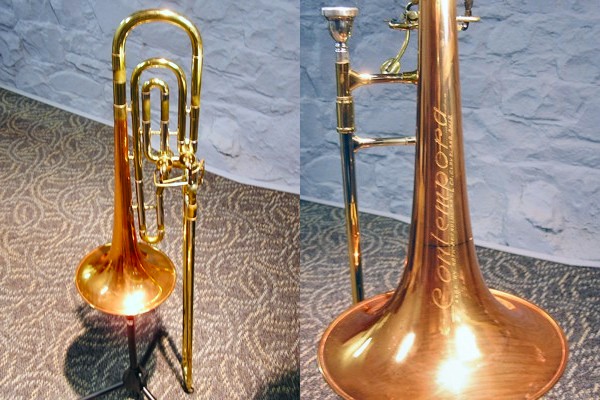
Contempora Bass Trombone, Model 78-X [SN 59942, c.1960]. Photo source: eBay.
'More carrying power, best for tonal quality, fast response, finest intonation' ... are the enthusiastic comments on noted symphony players such as Allen Ostrander, Louis Counihan and Kauko Kahila about their new Contempora Bass Trombones. Model 72-X with 9½" or 10" bronze bell, with the built-in slide to E. Model 78-X with double valve. A Bass Trombone played and enthusiastically endorsed by symphony players in this and foreign countries.

The "Stereophonic" Story
The Contempora "Stereophonic" double-valve bass trombone was launched in fall 1958. Designed in collaboration with Kauko Kahila, Allen Ostrander and Louis Counihan, the "Stereophonic" was one of the first widely available bass trombones with two rotor valves permanently attached to the horn. The design provided players with a fast and simple way of lowering the overall pitch of the trombone to E and enabled them to play technical passages such as the low B glissando in Bartok’s “Concerto for Orchestra”.
1961-1964
RMC/Reynolds (Cleveland, Ohio)
Sometime after Richards Music purchased Reynolds in 1961, the product catalog was renumbered. The old numbers were replaced with a new scheme that reflected the type of instrument. To the best of knowledge, the instrument specifications did not change, just the model numbers.
Model TO-01
Reynolds "Stereophonic" Contempora Bass Trombone
Bore: .564"
Bell: 10"
Materials: bronze-alloy bell; brass main tuning crook and gooseneck; nickel-silver bracing and trim, outside slide tubes and slide receiver
Valve: two rotary valves with dependent F/flat E attachments; brass with nickel-silver outer slide tubes
Slide: brass outer slides with nickel-silver sleeves; chrome-plated nickel silver inner slide tubes; chrome-plated hand grips
Finish: polished brass with clear lacquer finish
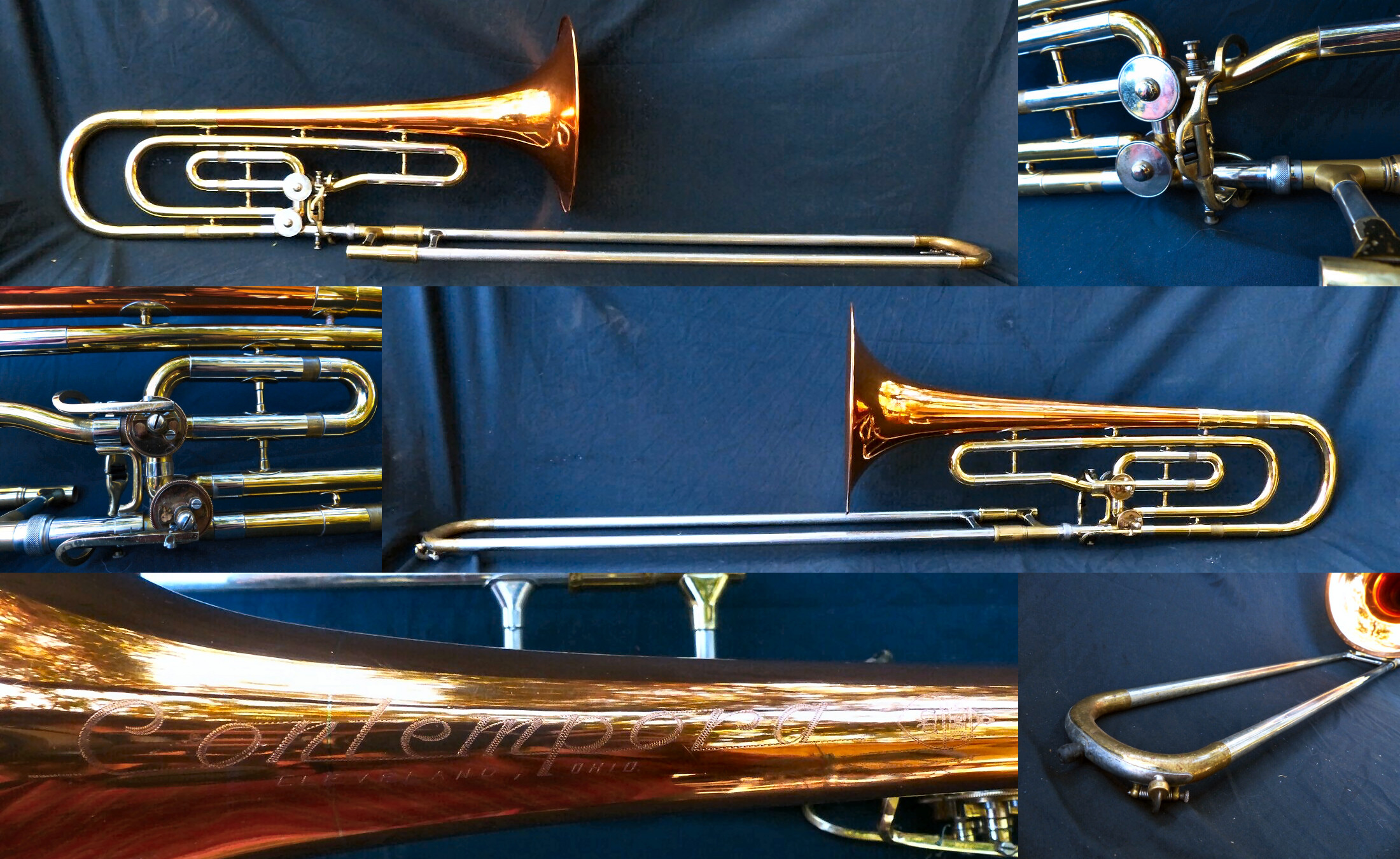
Contempora Bass Trombone, Model TO-01 [SN 69xxx, c.1962]. Photos used with permission from David Otey, Horn Haven Music (eBay ID: schnook64).
Model TO-02
Reynolds "Philharmonic" Contempora Bass Trombone
Bore: .564"
Bell: 9½" or 10"
Materials: bronze-alloy bell; brass main tuning crook and gooseneck; nickel-silver bracing and trim, outside slide tubes and slide receiver
Valve: rotary valve with closed-wrap F attachment; second tuning slide to E; brass with nickel-silver outer slide tubes
Slide: brass outer slides with nickel-silver sleeves; chrome-plated nickel silver inner slide tubes; chrome-plated hand grips
Finish: polished brass with clear lacquer finish
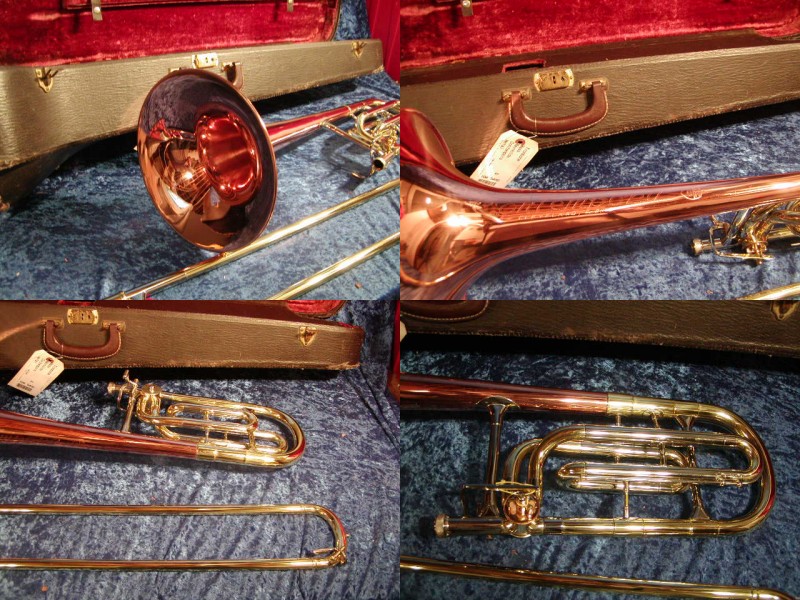
Contempora Bass Trombone, Model TO-02 [SN unknown, c.1961-64]. Photo source: eBay.
Model TO-03 (?)
Reynolds "Symphony" Contempora Bass Trombone
While it doesn't appear in a c.1963 RMC/Reynolds catalog, the "Symphony" model continued to be produced during the RMC period.
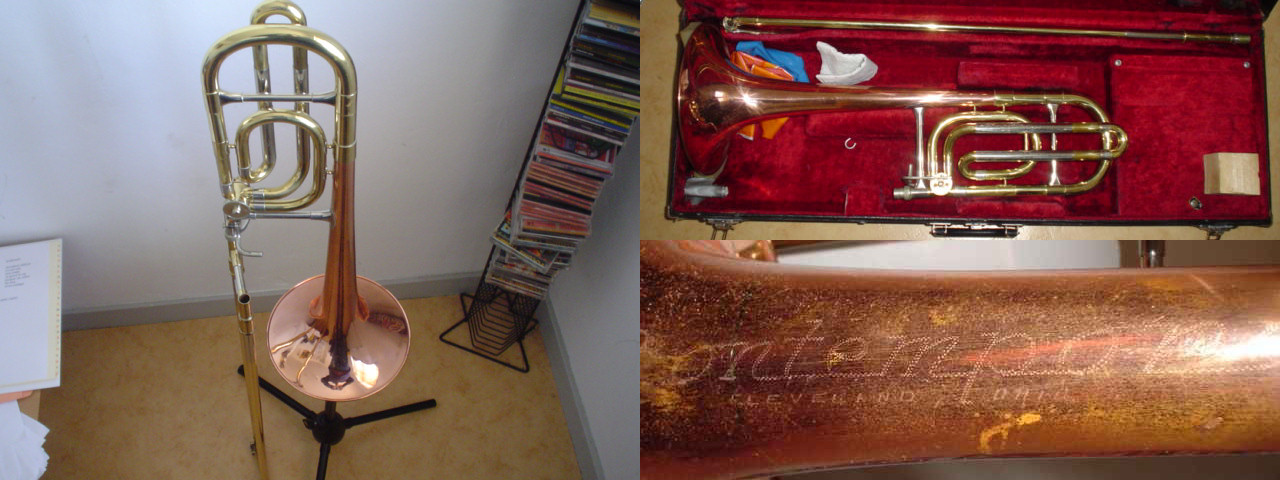
Contempora Bass Trombone, "Symphony" Model [SN 78045, c.1963-64]
[Reynolds Stereophonic Contempora Bass Trombone] is universally recognized as the very finest in bass trombones. Built in Bb, it features the double rotor valves for changes to F and E and, therefore, is in reality a "triple horn". There is a separate tuning slide for each of the three sections to keep you permanently in tune. The slides are finest nickel-silver with integral stockings heavily plated with hard chrome. The bell is a special 10-inch bronze alloy.
1964-1975
Reynolds (Fullerton, Calif.)
After CMI purchased the assets of the F.A. Reynolds company at auction, all of the Contempora trumpets, cornets, trombones and French horns were made at the Olds factory in Fullerton, Calif. There were slight adjustments to the model specifications compared to the Cleveland-made instruments. For the Contempora bass trombone, there was a very small bore size adjustment and the change to the baked epoxy finish (vs. clear lacquer) that Olds was using.
Model TO-01
Reynolds "Stereophonic" Contempora Bass Trombone
Bore: .565"
Bell: 10"
Materials: bronze-alloy bell, brass main tuning crook, gooseneck; nickel-silver bracing and trim, outside slide tubes and slide receiver
Valve: two rotary valves with dependent F/flat E attachments; brass with nickel-silver outer slide tubes
Slide: brass outer slides with nickel-silver sleeves; chrome-plated nickel silver inner slide tubes; chrome-plated hand grips
Finish: polished brass with baked epoxy
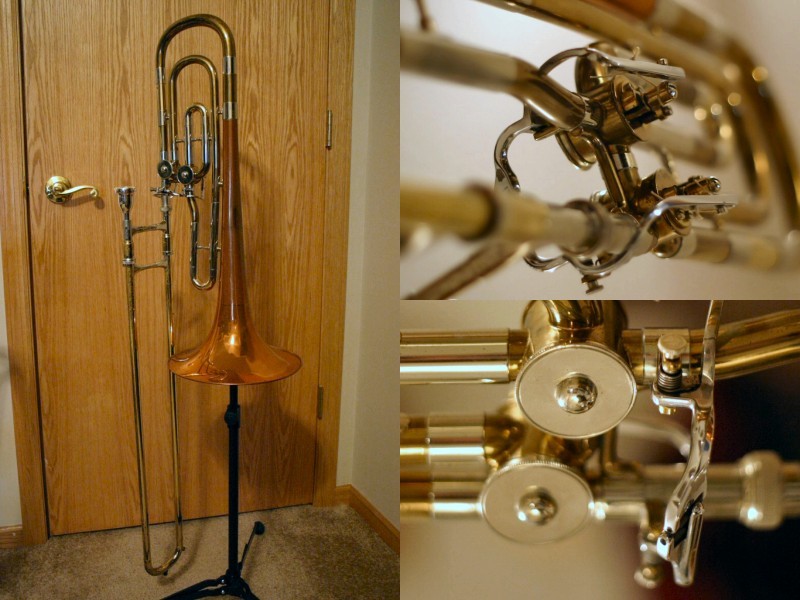
Contempora Bass Trombone, Model TO-01 [SN 257775, c.1970]. Photos used with permission from ElShaddai Edwards.
Model TO-02
Reynolds "Philharmonic" Contempora Bass Trombone
Bore: .565"
Bell: 10"
Materials: bronze-alloy bell, brass main tuning crook and gooseneck; nickel-silver bracing and trim, outside slide tubes and slide receiver
Valve: rotary valve with closed-wrap F attachment; second tuning slide to E; brass with nickel-silver outer slide tubes
Slide: brass outer slides with nickel-silver sleeves; chrome-plated nickel silver inner slide tubes; chrome-plated hand grips
Finish: polished brass with baked epoxy
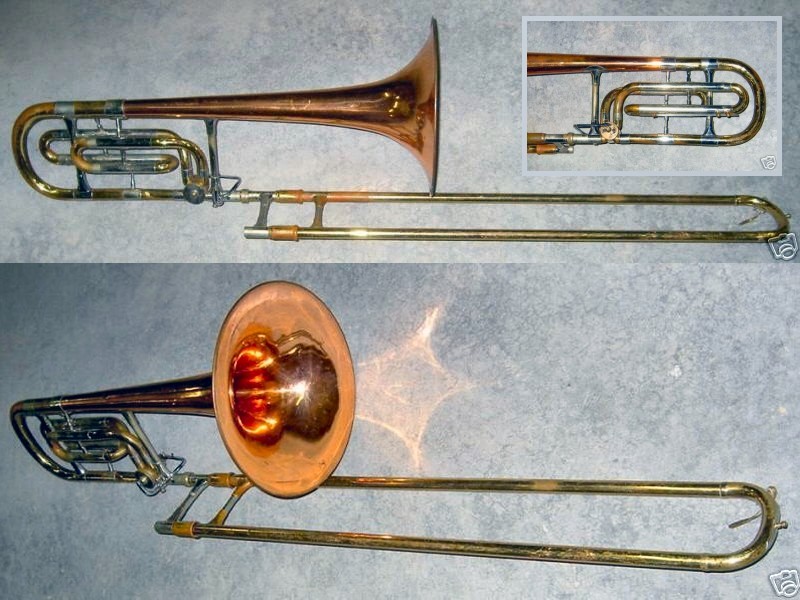
Contempora Bass Trombone, Model TO-02 [SN 218481, c.1966]. Photo source: eBay.
A 'triple horn' in Bb with two rotor valves for changes to F and E. Separate tuning slide for each section keep you permanently in tune. Special 10" bronze alloy bell.
[The TO-02 is the] same as model TO-01 but with single rotor valve for change to F, and "E pull" slide with adjustable stop guage, separate from F tuning slide.
1976-1979
Reynolds (Fullerton, Calif.)
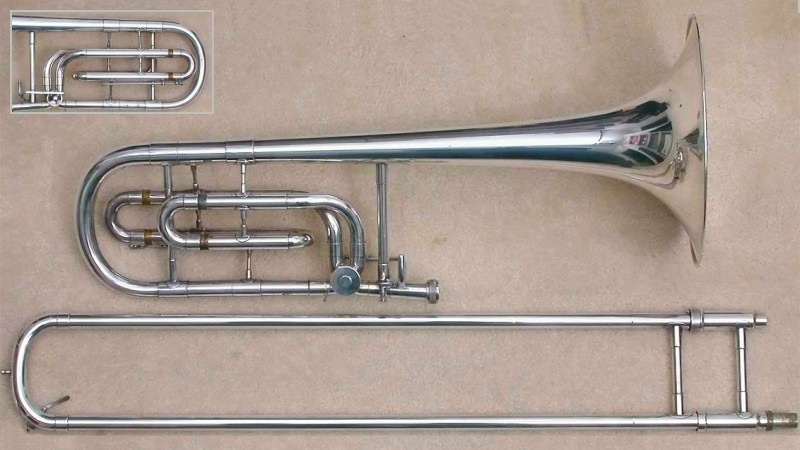
In 1970, Reynolds sold the Abilene (Texas) plant to Conn and merged all production lines with Olds in Fullerton. In most cases, a horn would come off the California production line and become either a Reynolds- or Olds-branded instrument based on detailing and finish. For example, the Olds Superstar V-25 bass trombone (shown below) is the same as the Contempora "Philharmonic" with Olds-style bracing and a silverplate finish. The Contempora bass trombones were generally an exception to the homogenized approach, but finally even they couldn't escape change. Circa 1976, the distinctive Contempora bronze bells were replaced with standard red brass.
Model TO-01
Reynolds "Stereophonic" Contempora Bass Trombone
Bore: .565" (.585" rotor)
Bell: 10"
Materials: red-brass bell, brass main tuning crook, gooseneck; nickel-silver bracing and trim, outside slide tubes and slide receiver
Valve: two rotary valves with dependent F/flat E attachments; brass with nickel-silver outer slide tubes
Slide: brass outer slides with nickel-silver sleeves; chrome-plated nickel silver inner slide tubes; chrome-plated hand grips
Finish: polished brass with baked epoxy
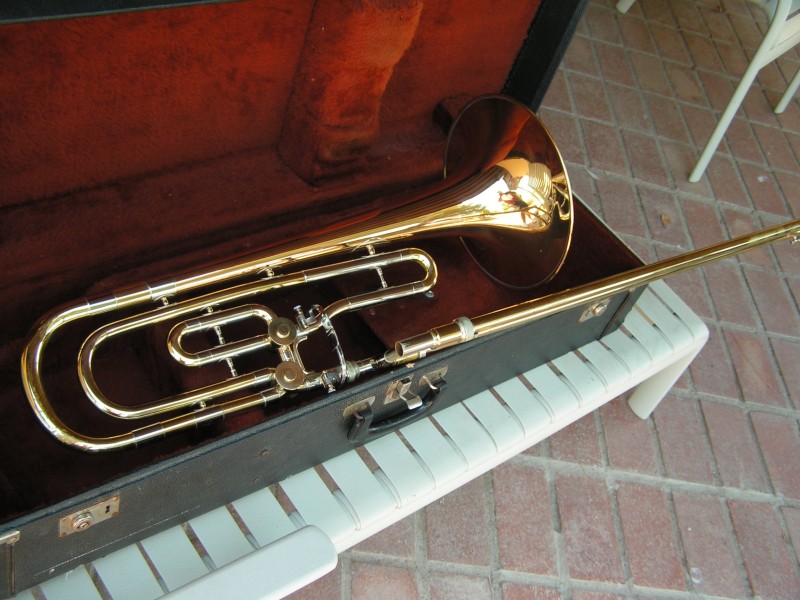
Contempora Bass Trombone, Model TO-01 [SN A41211, c.1979]. Photos used with permission from Bob Weller [eBay: fairllane57].
[The Contempora TO-01] bass trombone features special rotors for the professional's professional. [This] instrument offers all of the advantages of a single rotor bass Bb and F trombone with three separate tuning slides. The E valve extends the range to low B. The large bore and bell provide the robust tone demanded in contemporary music.
The Contempora [TO-02] bass trombone has been designed for the professional and the advanced player. The red-brass bell gives this instrument a richer, darker sound and excellent projection. The single rotor converts the normal B♭ bass trombone to F. Separate F tuning slide and an E slide with adjustable stop guage.
Model TO-02
Reynolds "Philharmonic" Contempora Bass Trombone
Bore: .565" (.585" rotor)
Bell: 10"
Materials: red-brass bell, brass main tuning crook and gooseneck; nickel-silver bracing and trim, outside slide tubes and slide receiver
Valve: rotary valve with closed-wrap F attachment; second tuning slide to E; brass with nickel-silver outer slide tubes
Slide: brass outer slides with nickel-silver sleeves; chrome-plated nickel silver inner slide tubes; chrome-plated hand grips
Finish: polished brass with baked epoxy
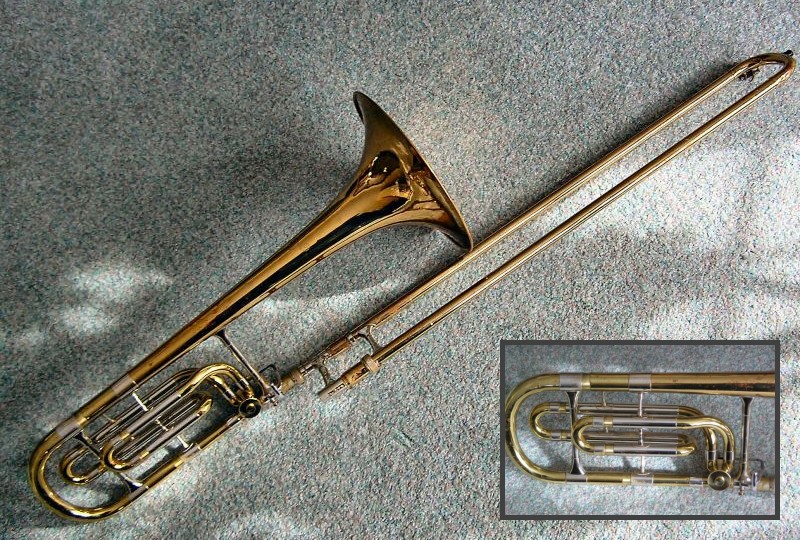
Contempora Bass Trombone, Model TO-02 [SN 309xxx, c.1976]. Photos used with permission from Wil Salo [eBay: tubatuna].
Compare the "Philharmonic" above with the Olds Superstar V-25 below.
NOTES
The "Stereophonic" originally featured attachments that provided F and flat E tuning as this was the simplest way to add the chromatic low C and B notes to the end of the slide. As more double-valve models entered the marketplace in the 1960s, players began to express a preference for F and D attachments, making it more efficient to play in the low register by placing the B closer in on the slide. Finally, in response to the increasing number of customer requests, the factory superintendent in charge of Engineering and Design at Olds' Fullerton plant, Zig Kanstul, designed an optional D attachment for the Contempora. Norman Rowe recalls the story:
I was the head tour guide at the Olds factory in Fullerton from 1967-1971 while a student at Cal-State Fullerton. During my time in Fullerton I did some gigs with Jeff Reynolds (prior to his L.A. Philharmonic days). One time we got together he was showing me his Bach to which he had added a second valve in Eb. (Mine was still in E, of course.) He explained how much better it was than the E and what he said made a lot of sense, so the next time I went to the factory to give a tour, I went into Zig Kanstul’s office (which was right off the room where we began the tours) and told him what Jeff had told me and asked if it would be possible to get an Eb extension for my Reynolds. He made light of it but said, “Yeah, sure.” Over the next several months I’d poke my head into his office and asked how the project was coming. He’d shrug it off with an “I’m working on it.”
Finally, one day I was getting ready to start a tour and he stuck his head out of his door and asked me to stop by when I was done. I did, of course, and it turned out that since I approached him with the extension idea, they had received letters from three owners of TO-01s (if I remember correctly, one was from New Orleans, one from St. Louis, and the other from somewhere in Ohio) who wanted the same thing, except they had all asked for extensions in D. So now it wasn’t such a crazy idea after all and he was ready to get serious about it. We played with some ideas and tried to come up with something that could be in either Eb or D so that all of us could have what we had asked for. It just wouldn’t work, so he decided to produce a run of twelve D extensions and offered me one of them. I accepted, of course. Then he picked up an experiment in Eb and said he’d fix it up for me if I wanted it, otherwise it was going into the trash. Well, the Eb was what I wanted in the first place, so I said I’d like it. Therefore I ended up with the only factory-made Eb extension and one of only twelve factory-made D extensions.
Zig’s extensions were really a very simple design. The E tuning slide was pulled out, the extension angled around the F tubing above it, then the tuning slide was inserted into the end. But because of the need to angle around, that part of the extension length was unavailable to be used as extra tuning slide length, so there just wasn’t enough to pull the Eb down to D. If it had been available, he probably would have just made a separate tuning slide for it that would be left in for Eb and pulled for D. (And I wouldn’t have had the Db and C modes, so I’m glad it worked out that way.)
So he ended up having to make a separate D extension to satisfy those who wanted the D. The D, of course, is just a longer version of the Eb extension. And by using the original E tuning slide, no additional extra parts were needed. And the case design allowed the extension to be left on the instrument when packing the horn up. The design also allowed the two extensions to fit into each other and become the Db and C configurations. So unless I was using the horn in its original setting, I only had one “extra” piece kicking around. At first it tended to be the D extension, then soon it became the Eb most of the time.
I started off using the Eb extension most of the time and playing around with the D some. Eventually I went to using the D most of the time. Then one day while sitting in orchestra rehearsal and doing what trombone players usually do during orchestra rehearsals (twiddling thumbs), it struck me that the extensions would fit into each other. So I picked up the bone and extensions, went out into the hall, pulled the tuning slide out of the D, stuck the Eb into it, then put the tuning slide into the Eb, and I had a Db extension! Then I pulled the slides as far as they would go: C!! So I can have that second valve in E, Eb, D, Db, or C - the most versatile dependent second valve anywhere. At least using factory-made parts. I did a studio gig in Dallas shortly before I got [my Olds P-24G] during which I used each variation on at least one piece except maybe the E. Sometimes one just worked better than the others because of the way that particular number lay.
Norman Rowe mentioned a limited run of factory-made D extensions for the double-valve Contempora. His horn is shown in the upper left below, along with several examples of custom-made extensions that have been spotted "in the wild".
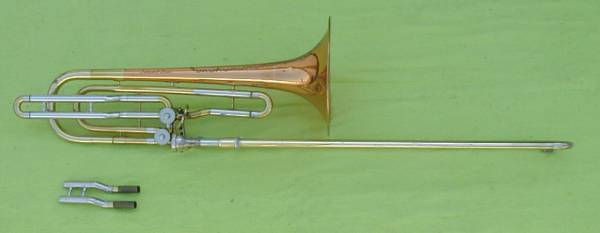
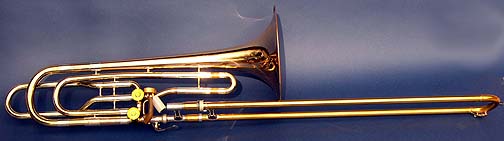
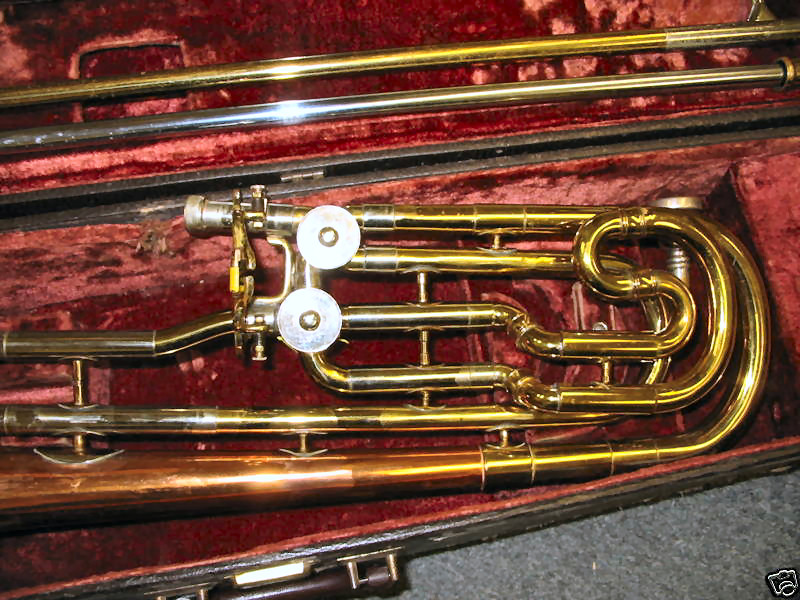
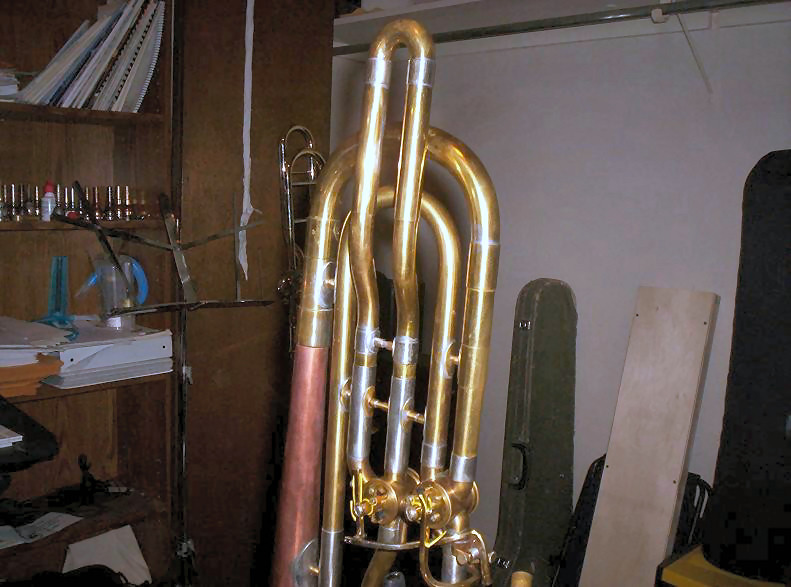
Henry Kavett recalls the following story regarding demo horns made for the Metropolitan Opera Orchestra:
I bought my double valve Contempora from the legendary teacher Donald Reinhardt, in 1970. He had four of these beasts in his studio which he said had been the demo horns made for the Metropolitan Opera (NY) orchestra. I had my pick of the litter. My teacher had studied with him and brought me for a lesson and to get a “new” trombone. It is a sentimental favorite — a decent, multipurpose instrument that is essentially a compromise sort of horn. The top is great as is the middle, but the bottom was stuffy for me. After fitting it with a Callet lead pipe, the output was considerable better and more focused. Though I switched to another instrument about three years ago, this is still a terrific horn…
The popularity of Reynolds bass trombones still lingers in the U.K., where Chris Stearn reports that Gerry McElhone (Covent Garden) used a Reynolds before retiring in the late-1990’s and Leslie Lake of the English National Opera still actively uses a Contempora bass trombone on a regular basis:
Les wore out his original Reynolds slide, but found another newer one. Then, about ten years ago, I sold him an early Reynolds bass that was in as new condition. I had bought the instrument from the widow of Harry Spain, longtime bass trombonist with the Royal Philharmonic Orchestra, who had used it for a short time in the sixties, then stored it. I used it at the Scottish Opera for a year or so, then sold it on to Les. He still plays it.
Renold O. Schilke studied the Contempora design when he was thinking about marketing a trombone line under the Schilke name, but wound up designing the original Yamaha bass trombones instead. Mike Suter recalled the following story for the trombone-l community:
In the early ’70s, I was in Chicago and stopped by Schilke to say ‘hi’ to Phil Warsip and look around a bit. The old man came out, all excited, and said “you have to play my new bass trombone.” He brought out a stacked Bb-F-E horn that looked for all the world like an exact copy of a double rotor Reynolds Contempora, roller linkages, dependent E branch, Reynolds pattern ferrules and all, except that it had a huge bell - a lot bigger than my Holton. I know it had a leaderpipe because my mouthpiece fit the receiver. But who knows how long or short it may have been. It was clearly an orchestral horn: you had to kind of boss it around to get what you wanted. After I’d played it for a while, he asked me what I thought of it. Somewhere in the first two sentences I mentioned its striking resemblance to the Reynolds. He snatched the horn from me and stomped off. Warsip just kind of smiled and said that I’d pay for that down the road.
Paul Rawlins confirms that Renold Schilke bought twelve Reynolds Contempora bass trombones (of which Paul later bought one) in the early 1960s just before Richards Music went bankrupt and production moved out of Cleveland.
The purpose of this website is to preserve the history of the F. A. Reynolds Company and the distinctive qualities of its brass instruments. Contempora Corner and contemporacorner.com are not related or associated in any way to the former or current F.A. Reynolds Company.
Copyright © 2004-2025 ElShaddai Edwards. All Rights Reserved. Terms of Use.