
Reynolds (Professional) Trumpets

For the first 10-12 years of production, the Reynolds trumpet was simply known as the "F.A. Reynolds Trumpet". Various configurations of materials and finishes were available or, more likely, evolved over time, but it was still just Reynolds (along with Roth and Regent, which were the intermediate and student model lines available).
When the Emperor and Contempora models were introduced in the late 1940s, the company began to refer to its original trumpet as the "Professional" model, positioning it between the intermediate Emperor and artist-level Contempora horns. Multiple design options were still available, but now as different model numbers and eventually even different model names, as with the "Sterling" model.
1936-1946
F.A. Reynolds (Cleveland, Ohio)
Documented model numbers are not yet available for Reynolds' earliest trumpets. Instead, I've grouped the examples below by the combinations of parts made of nickel silver, brass and/or sterling silver — production dates are estimated through serial numbers and engraving patterns. The three key components that were variously available in nickel silver were the leadpipe, the balusters (upper valve casings) and the slide tubing coming from each valve. I've identified four material combinations so far (Models A-D), each with either a brass bell or sterling silver bell. For the sake of consistency with known model numbers, I am using the model number (50) that the Reynolds trumpet was known with in the late 1940s.
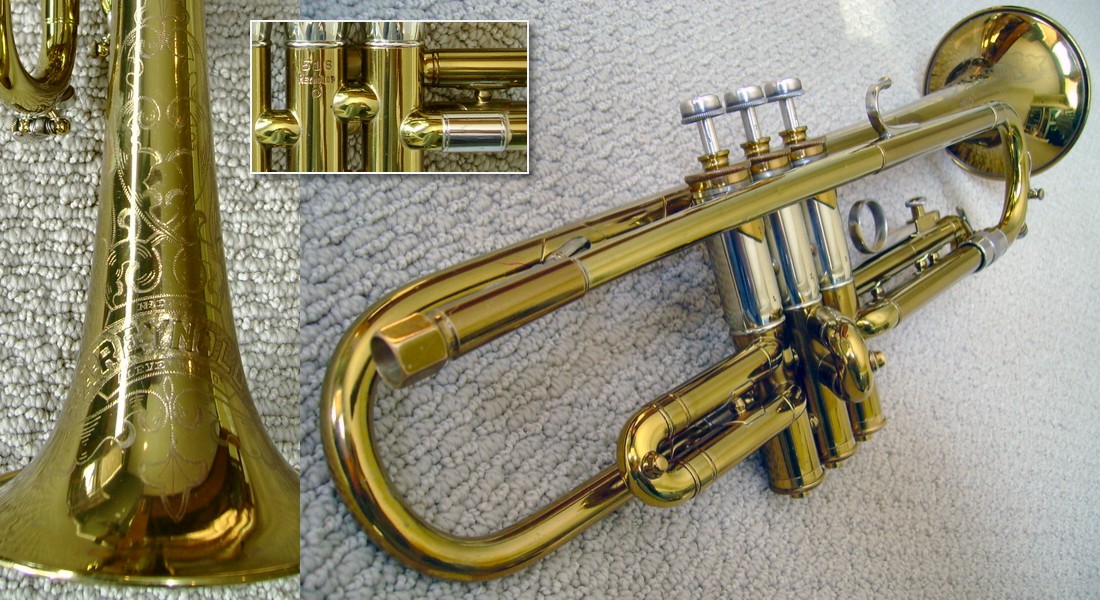
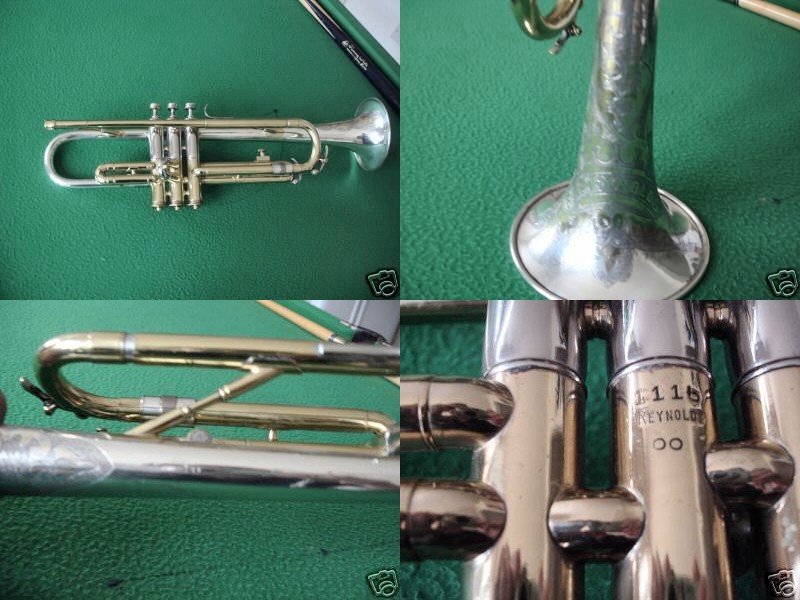
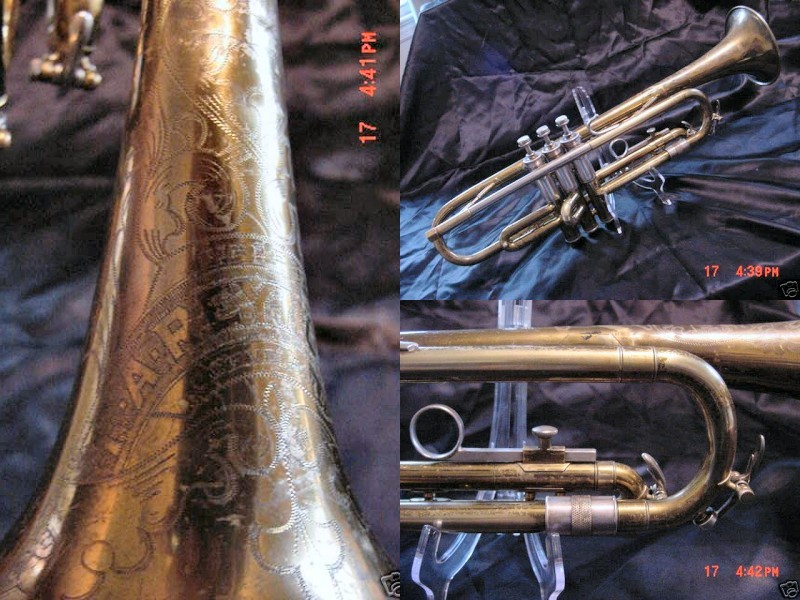
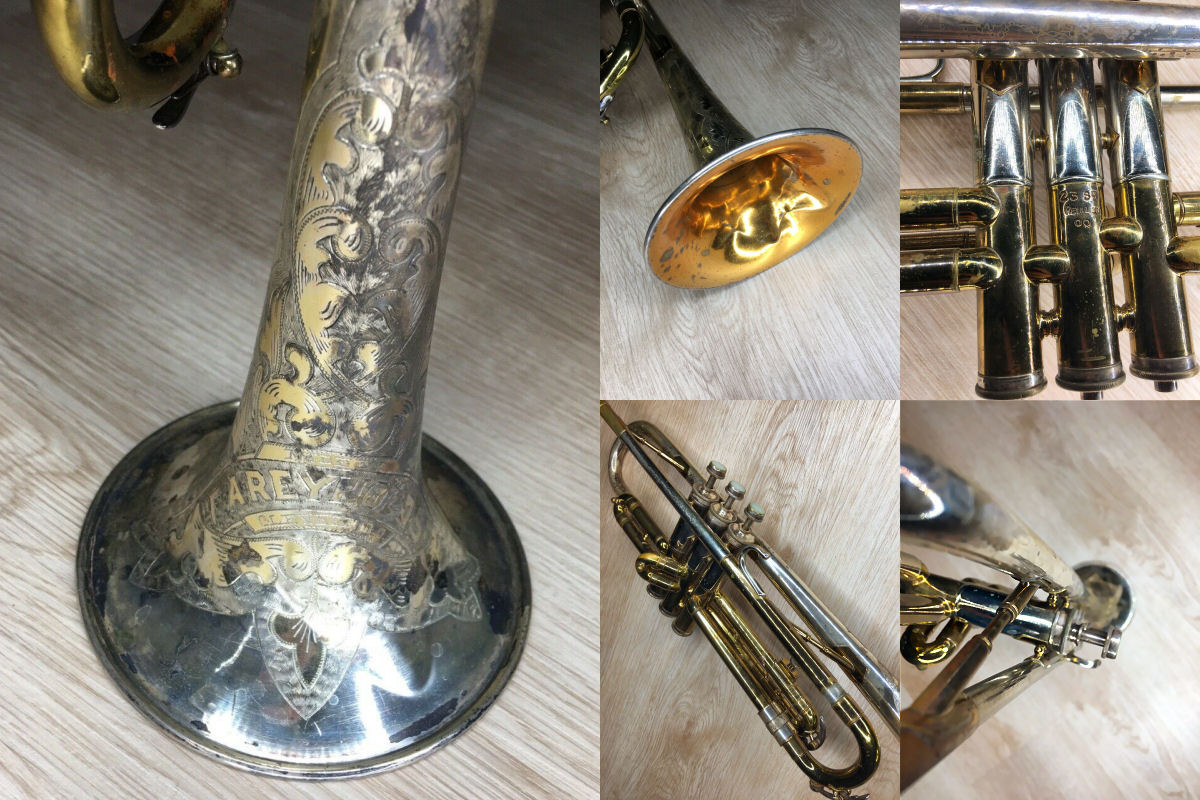
Trumpets from Reynolds' first decade of operations feature an ornate engraving pattern across the width of the bell flare. Both brass and sterling silver bells feature significant filigree with the latter adding inlay gold as well.
Model 50A
Reynolds trumpet with B♭/A tuning ring
Bore: .448" (o) or .458" (oo)
Bell: 4-5/8"
Materials: brass with nickel-silver upper valve casings (balusters)
Valves: top-loaded, inner-spring, solid nickel-silver valve pistons
Finish: polished brass with clear lacquer finish
50A with brass bell (c.1936)
50A with sterling silver bell (c.1937)
Model 50B
Reynolds trumpet with B♭/A tuning ring
Bore: .448" (o) or .458" (oo)
Bell: 4-5/8"
Materials: brass with nickel-silver leadpipe and upper valve casings (balusters)
Valves: top-loaded, inner-spring, solid nickel-silver valve pistons
Finish: polished brass with clear lacquer finish
50B with brass bell (c.1940)
50B with sterling silver bell (c.1938)
Model Note
Models before serial number 5000 featured an adjustment ring on the main tuning slide for “quick change” B♭/A tuning. This is a feature that Foster Reynolds undoubtedly carried over from his work at H.N. White, where a similar tuning ring had been featured on the King “Master” model trumpets and cornets.
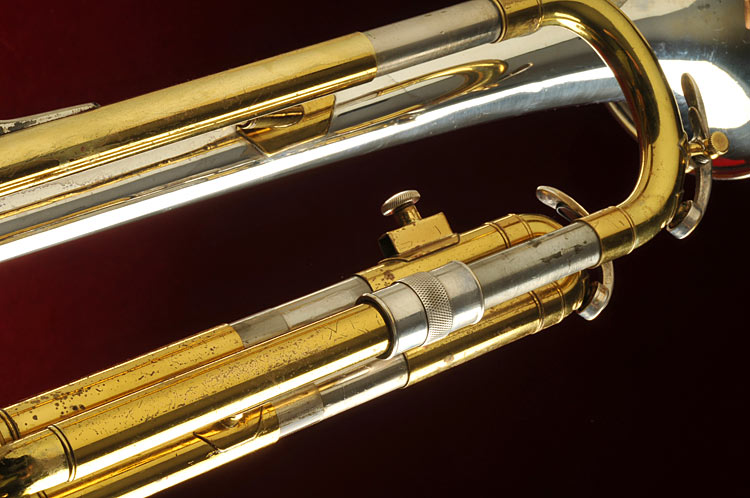
Unlike the F.A. Reynolds cornet, which is an obvious and direct descendant of the King "Master Model" cornet, the early Reynolds trumpets do not have as clear a lineage. The "Master Model" trumpet was discontinued in 1924, replaced by the King "Liberty" model. From 1920-1933, the Liberty trumpet underwent design revisions that Foster Reynolds would have been very familiar with, and which are reflected in his own trumpets.
However, one source notes, that while the externals may be similar, the King "Liberty" trumpet had bottom-sprung valves, different bracing between the lead pipe and bell, and what appears to be a tighter wrap. Instead, it's noted that H.N. White Co. may have supplied Vincent Bach with valves when the latter was starting out and that Foster Reynolds would have been very aware of the Stradivarius model, to which the Reynolds trumpets reportedly sound very similar when played side-by-side.
One final note—the Reynolds trumpet was documented as Model 50. The King "Liberty" trumpet was model no. 1050 in the H.N. White catalog. Whether this was coincidence, competition or tacet acknowledgement of the instrument's history may never be known.
World War II
F.A. Reynolds Co. was awarded at least three separate contracts for band instruments by the United States Army Quartermaster between 1943 and 1945. The contracts totaled nearly $200K ($3M in 2022) and allowed the relatively new company to continue focusing on instrument production when many more-established manufacturers, e.g., F.E. Olds and Conn, were forced to shut down instrument lines and produce wartime equipment.
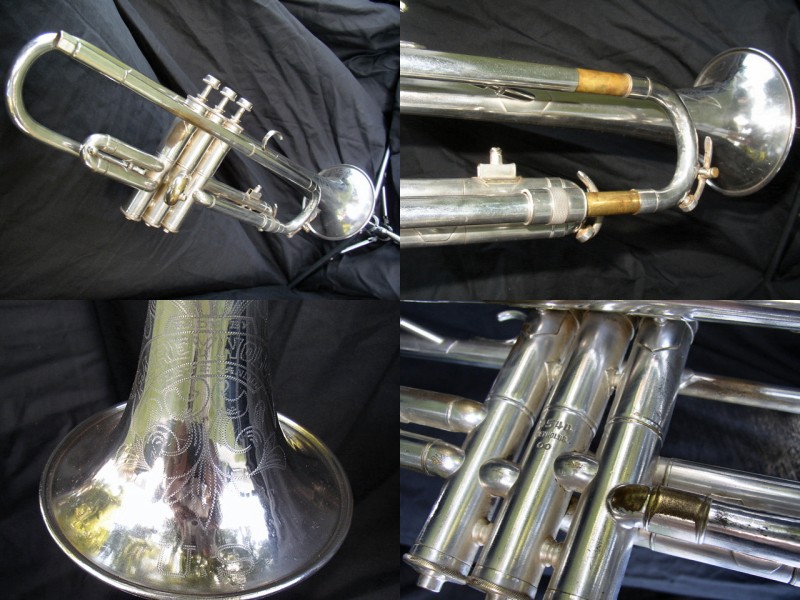
Details of each contract are not available, and it is not specified which service bands received the instruments, though anecdotal evidence suggests that the bands of the U.S. Army Air Forces (USAAF) were recipients, having just organized in 1941. These instruments have a silverplate finish with unique engravings and a large "U.S." mark near the rim of the bell.
The "U.S." trumpet has a slightly larger bell diameter (4-7/8" vs. 4-5/8") than standard Reynolds trumpets.
Reynolds Trumpet with USAAF military engraving and B♭/A tuning ring (c.1941)
Bore: .458"
Bell: 4-7/8"
Finish: silverplate finish
Reynolds B♭ Trumpet with USAAF military engraving (c.1948)
Bore: .458"
Bell: 4-7/8"
Finish: silverplate finish
1946-c.1949
F.A. Reynolds, division of Scherl & Roth (Cleveland, Ohio)
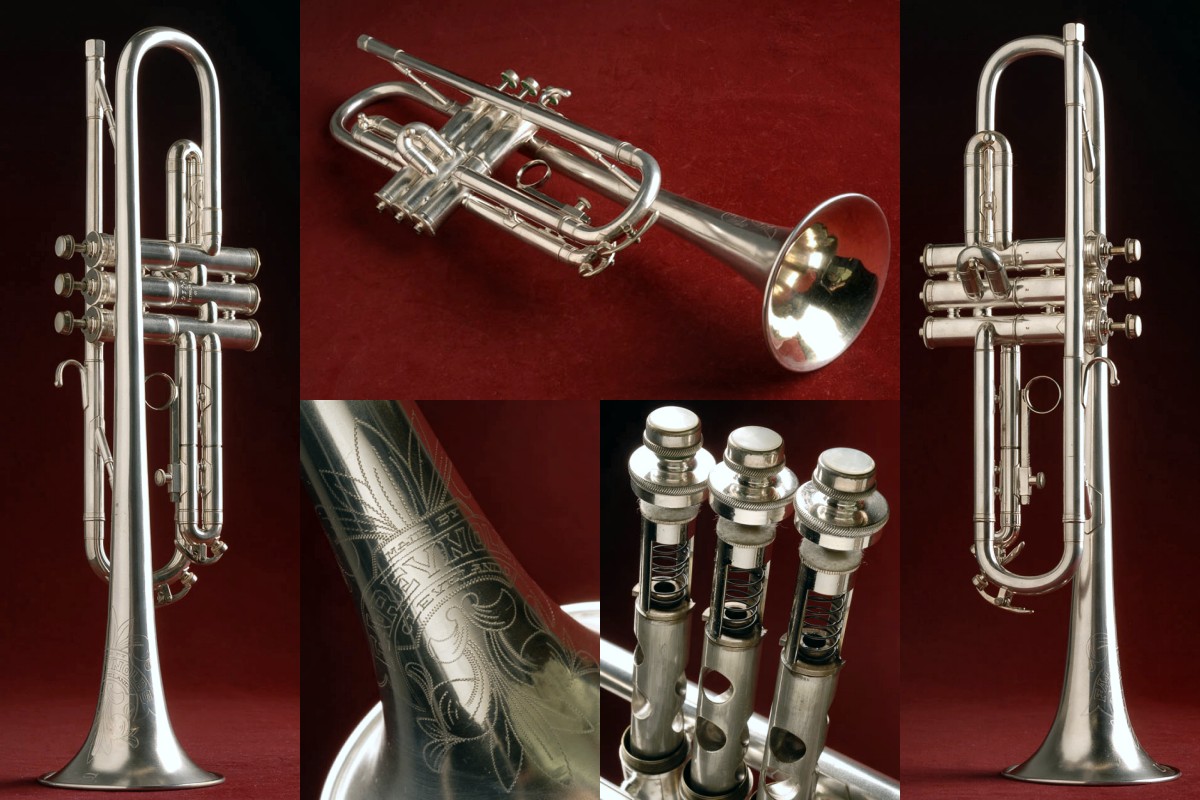
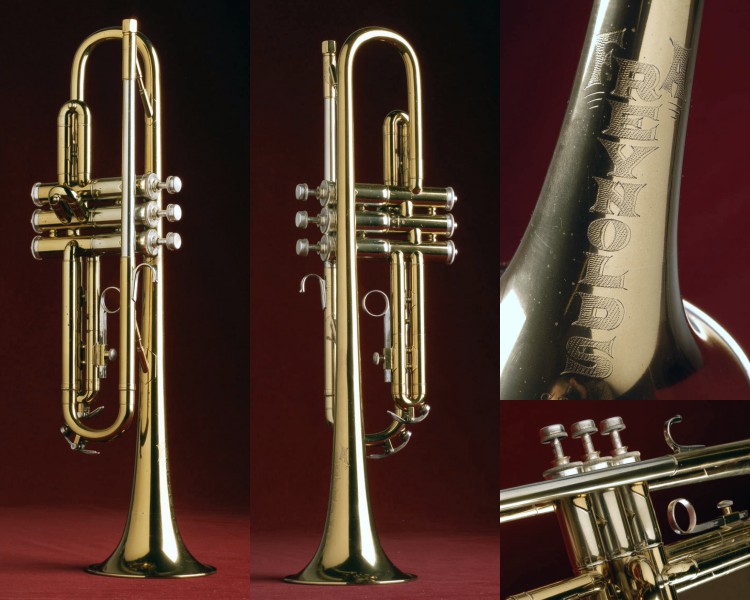
After Scherl & Roth took over operations in 1946, it appears that the engraving pattern changed to a vertical monogram style. The brass bells were much simpler in style than the sterling silver bells and would not have required as much “finishing” time on the production line. The change in engraving patterns happened around SN 9000.
Model 50B
Reynolds B♭ trumpet
Bore: .458" (oo)
Bell: 4-5/8"
Materials: brass with nickel-silver leadpipe and upper valve casings (balusters)
Valves: top-loaded, inner-spring, solid nickel-silver valve pistons
Finish: polished brass with clear lacquer finish
50B with brass bell (c.1947)
50B with sterling silver bell (c.1947)

Model 50C
Reynolds B♭ trumpet
Bore: .458" (oo)
Bell: 4-5/8"
Materials: brass with nickel-silver leadpipe
Valves: top-loaded, inner-spring, solid nickel-silver valve pistons
Finish: polished brass with clear lacquer finish
50C with brass bell (c.1946)
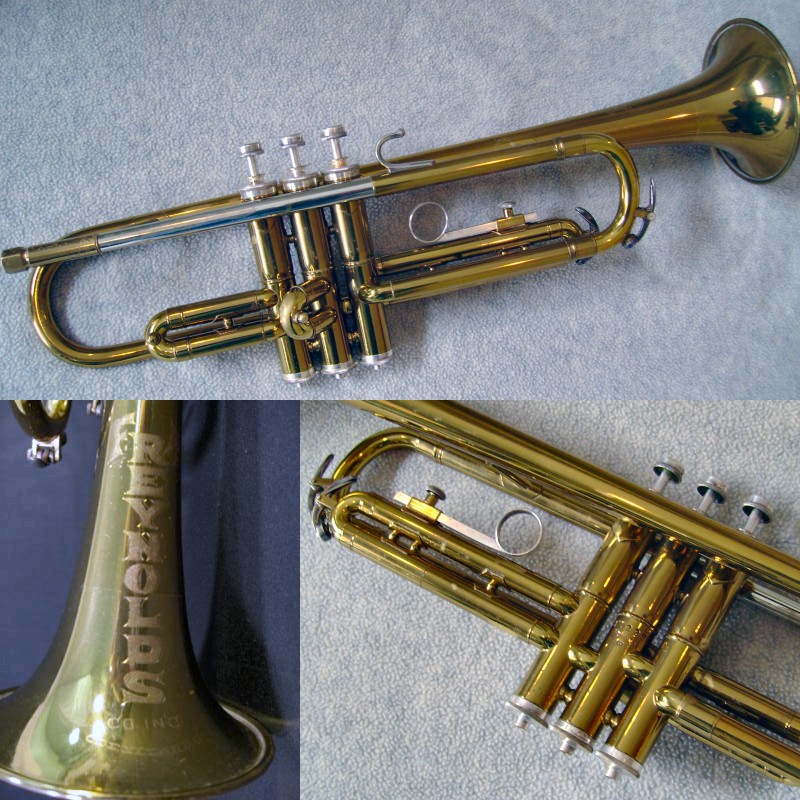
50C with sterling silver bell (c.1946)
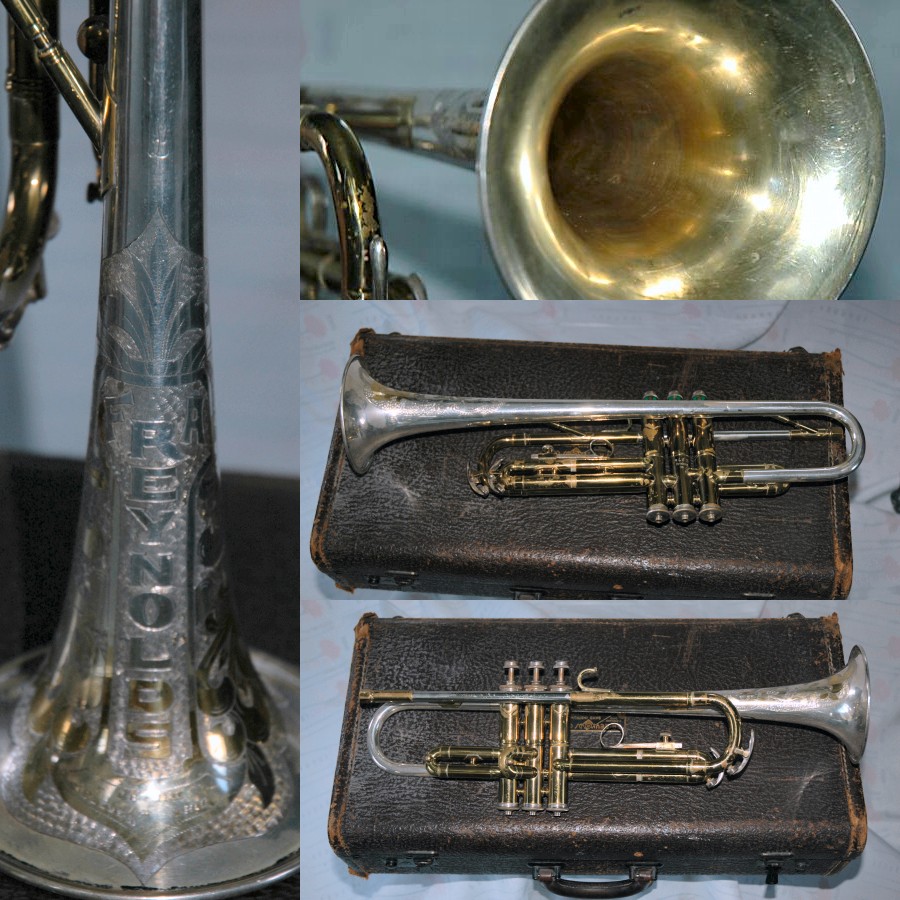
Model 50D
Reynolds B♭ trumpet
Bore: .458" (oo)
Bell: 4-5/8"
Materials: brass with nickel-silver leadpipe, upper valve casings (balusters) and outer valve slides
Valves: top-loaded, inner-spring, solid nickel-silver valve pistons
Finish: polished brass with clear lacquer finish
50D with brass bell (c.1948)
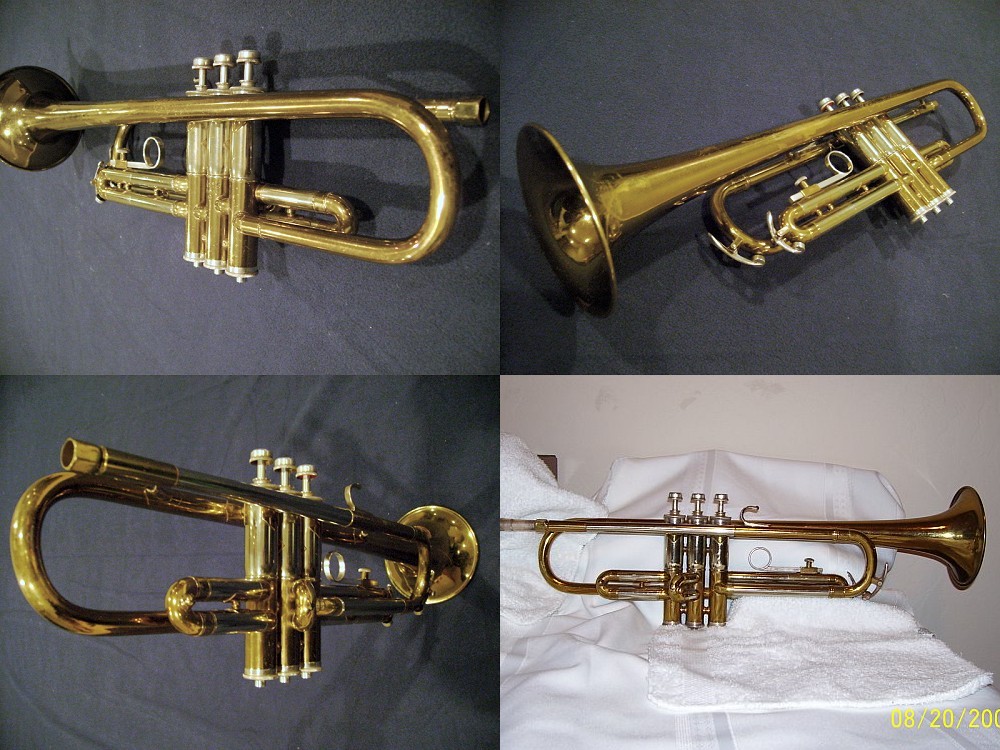
50D with sterling silver bell (c.1948)
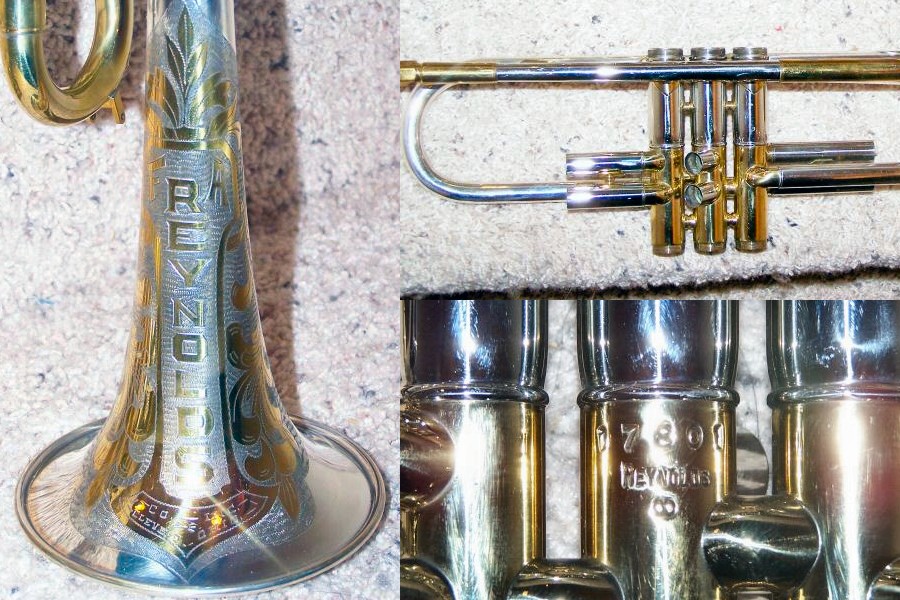
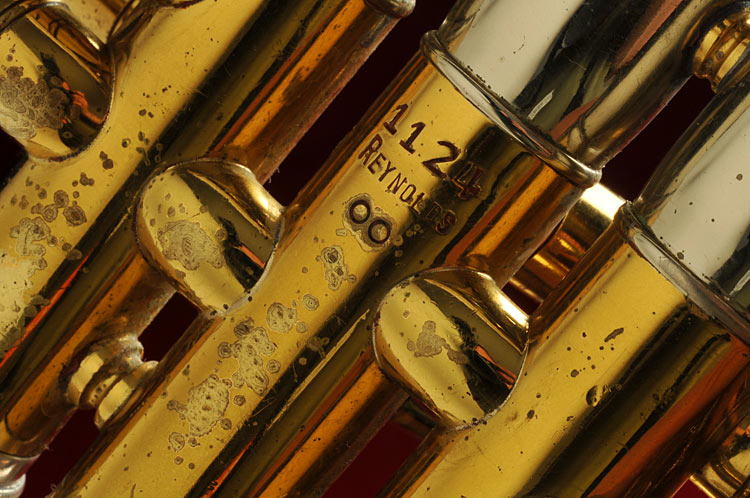
Model Note
The “oo” marking on the valve casings of many early F.A. Reynolds trumpets is believed by Zig Kanstul (as reported by Jim Straub) to be a sideways “8″ designating the bore size as .458″ (inside diameter of the second valve slide).
There are reports of smaller-bore models with a .448″ size as well; these may correspond to the less-common single “o” marking. Later models would be marked with "ML" (.458" medium-large bore) or "LB" (.462" large bore).
c.1949-1952
F.A. Reynolds, division of Scherl & Roth (Cleveland, Ohio)
Around 1949, there were minor design changes made to F.A. Reynolds trumpets: while the overall design and bell engravings remained the same, the updated models can be distinguished by their lower profile valve buttons and flat bottom valve caps. Serial number 21000 marks the approximate change to the updated design. In conjunction with these changes (and with the introduction of the Contempora and Emperor models), the Reynolds trumpet began to be designated as the “Professional” model.
Of the different variants listed above, only [D] appears to have been retained, now known as model nos. 50 and 51, with brass and sterling silver bells, respectively.
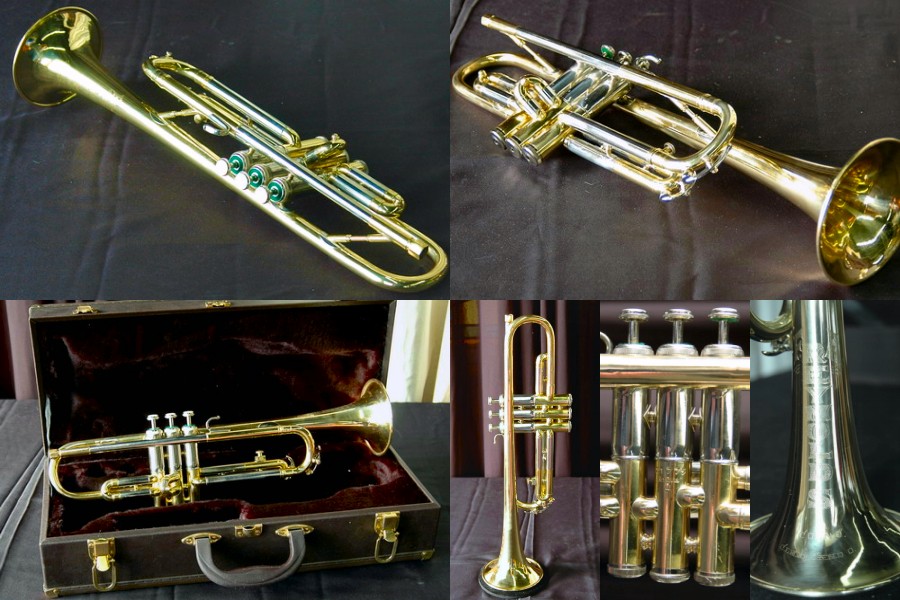
Model 50
Reynolds B♭ trumpet
Bore: .458"
Bell: 4-5/8" brass
Materials: brass with nickel-silver leadpipe, upper valve casings (balusters) and outer valve slide tubes
Finish: polished brass with clear lacquer finish
Model 51
Reynolds B♭ Silver Bell trumpet
Bore: .458"
Bell: 4-5/8" sterling silver with hand-burnished gold inlaid engraving
Materials: brass with nickel-silver leadpipe, upper valve casings (balusters) and outer valve slide tubes
Finish: polished brass with clear lacquer finish
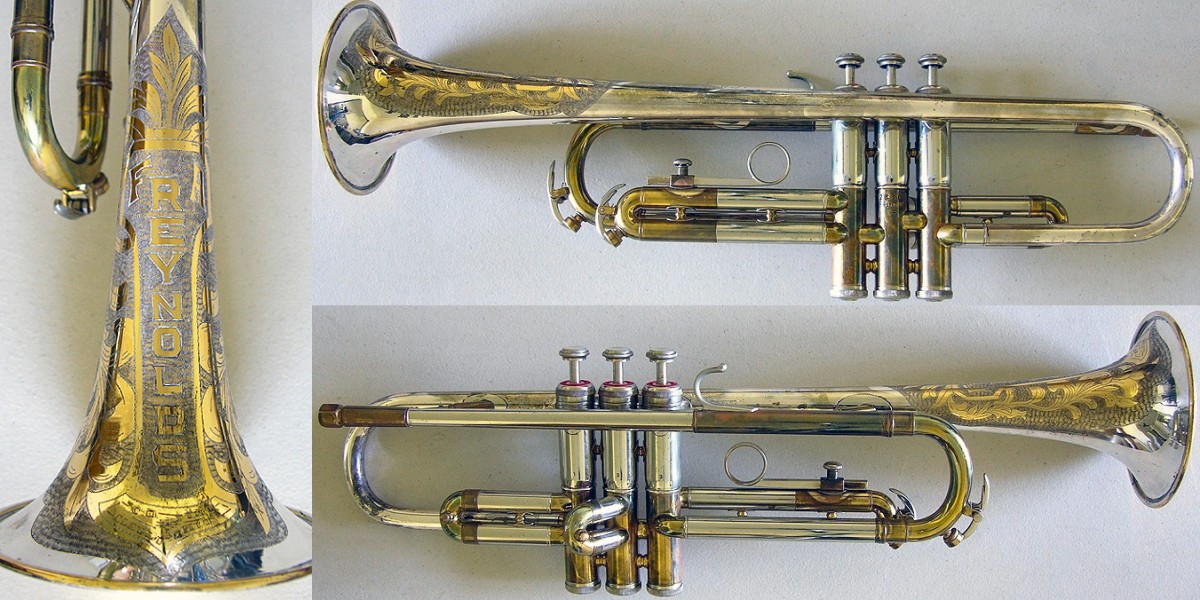
The Reynolds trumpet, graceful in design, free blowing, and with a tone quality which will please the most critical player, offer the discriminating musician an instrument of outstanding merit. Its velvet-like action is surefire at all times. Its overall length is 21 1/2 inches -- weighs 40 ounces, and has a 4 5/8 inch bell, perfectly balanced. It is truly an instrument for the artist.
1952-1961
Roth-Reynolds (Cleveland, Ohio)
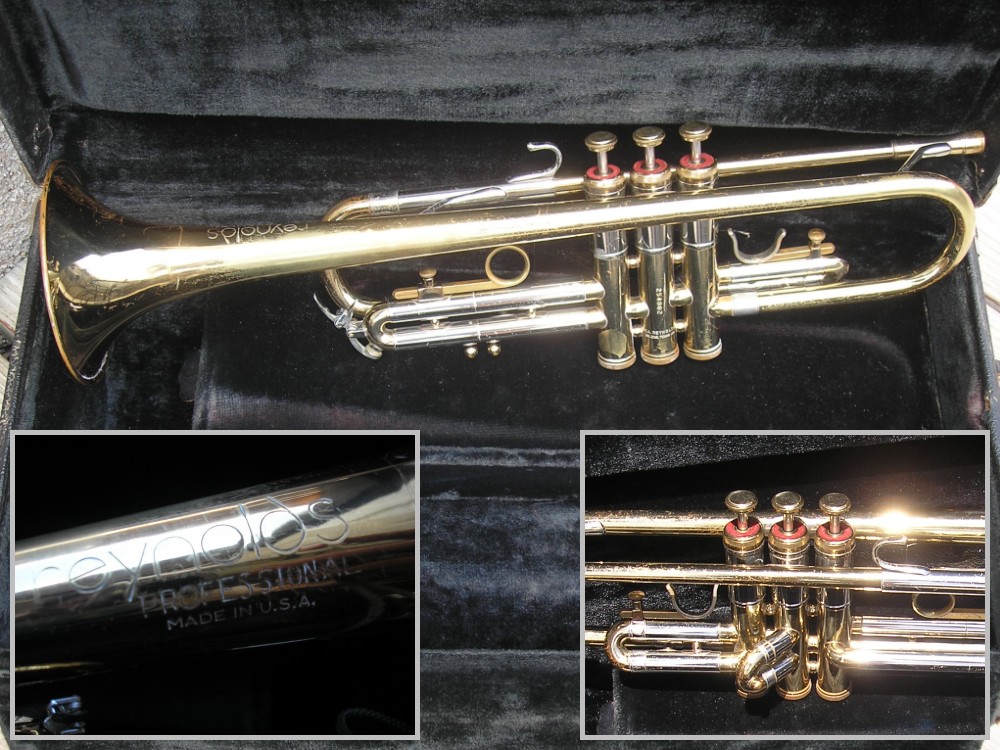
Reynolds trumpets made c.1952 and later are marked "Made by Roth-Reynolds" instead of "F.A. Reynolds". In addition, the main bell engraving changed to a lengthwise script that simply says “Reynolds” and product catalogs refer to them as “Professional” models. Serial number 30000 marks a general introductory point of these changes.
The model descriptions below are based on photos and other details. However, it must be said that variations in the materials used have been observed, similar to the A-D combinations described above. It's possible that Reynolds offered configuration options that weren't documented in the surviving product catalogs.
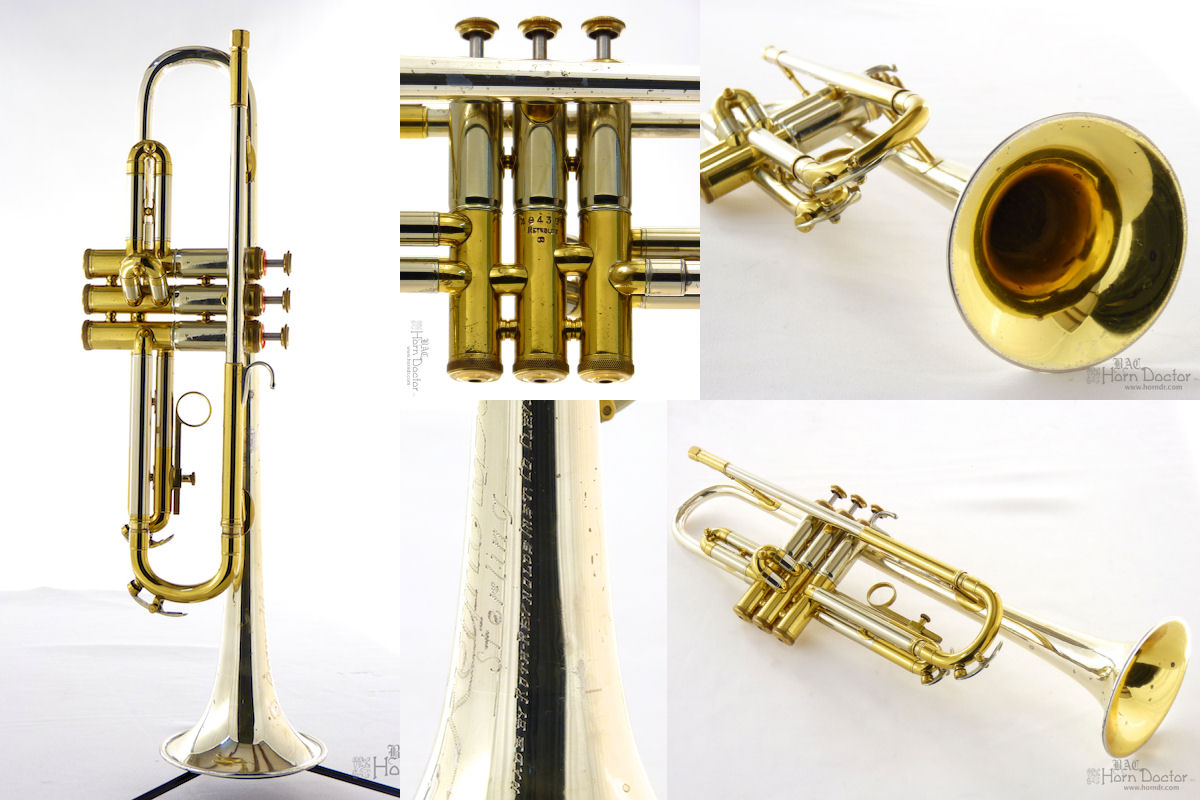
Reynolds continued to offer a sterling silver bell option throughout the 1950s and early '60s. The basic sterling silver bell (model 53) had an added "Sterling" word engraved below the new "Reynolds" script, while the deluxe sterling silver bell (models 51, 52) kept the fancy filigree and hand-burnished gold inlay that had distinguished those Silver Bell models over the previous decades. The latter do not appear to have added the "Sterling" engraving designation.
Model 50, brass bell, does not appear in the 1959 product catalog and may have been replaced by the introduction of the large-bore "Hi-Fi" model.
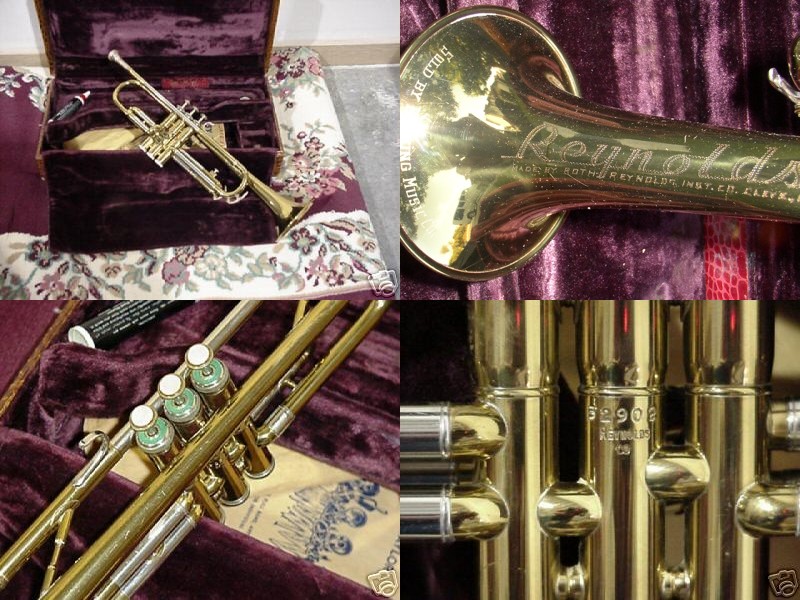
Reynolds Professional Cornets and Trumpets have been the choice of discriminating musicians for over two decades. Graceful design and famous free-blowing qualities distinguish the 'Professional' models. Instant valve response with solid nickel silver pistons. Built with either brass bell or beautifully finished sterling silver bell. All models equipped with deluxe Gladstone cases.
Model 50
Reynolds Professional B♭ trumpet
Bore: .458"
Bell: 4-5/8" brass
Materials: brass with nickel-silver leadpipe and outer valve slide tubes
Finish: polished brass with clear lacquer finish; optional silverplate with gold bell finish
Model 51
Reynolds Professional B♭ trumpet
Bore: .458"
Bell: 4-5/8" sterling silver with deluxe hand-burnished gold inlaid engraving
Materials: brass with nickel-silver leadpipe and outer valves slide tubes
Finish: polished brass with clear lacquer finish
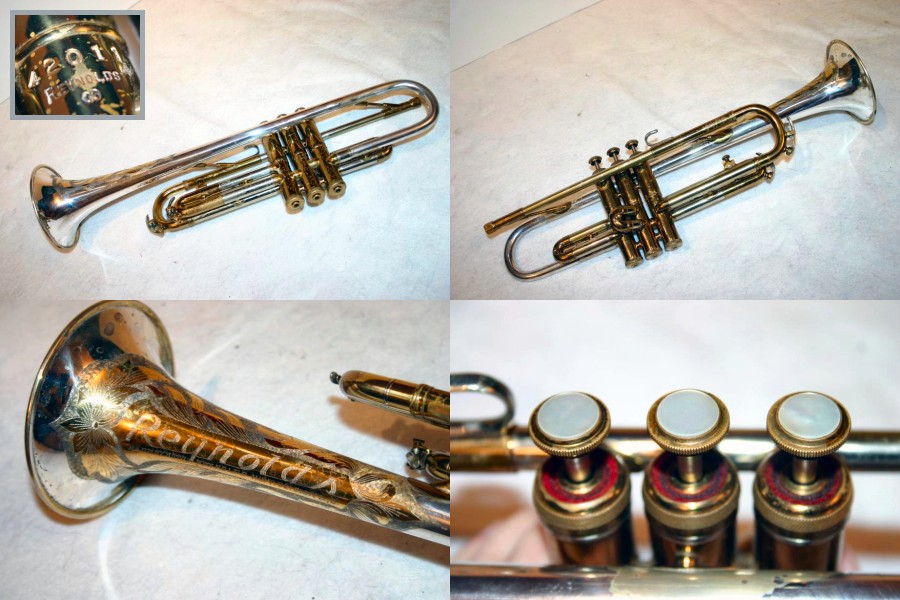
Model 52
Reynolds Professional B♭ trumpet with first-valve slide trigger
Bore: .458"
Bell: 4-5/8" sterling silver with deluxe hand-burnished gold inlaid engraving
Materials: brass
Finish: polished brass with clear lacquer finish
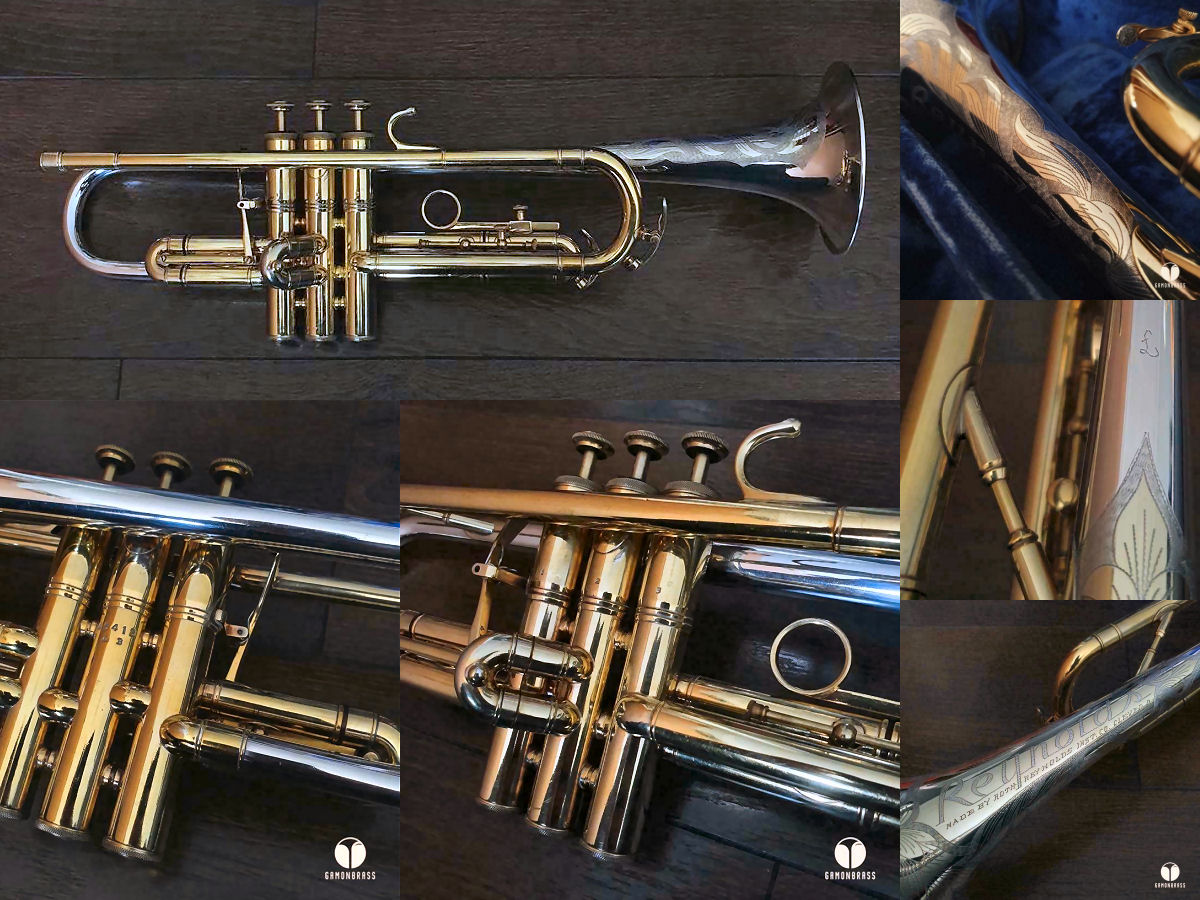
Model 53
Reynolds Professional "Sterling" B♭ trumpet
Bore: .458"
Bell: 4-5/8" sterling silver
Materials: brass with nickel silver leadpipe, upper valve casings (balusters) and valve outer slide tubes
Finish: polished brass with clear lacquer finish
The most glamorous trumpets used by the most discriminating players for over two decades. Fast action valves of solid nickel silver. Graceful design and excellent response. Regular model 50 with brass clear lacquered bell. Model 53 with beautiful sterling silver bell for well modulated and warm tonal qualities. Model 51, deluxe, sterling silver bell with hand-burnished gold inlaid engraving, the most distinctive instrument. All models equipped with deluxe Gladstone cases.
1961-1964
RMC-Reynolds (Cleveland, Ohio)
Sometime after Richards Music purchased Reynolds in 1961, the product catalog was renumbered. The old numbers were replaced with a new scheme that reflected the type of instrument. To the best of knowledge, the instruments did not change, just the model numbers. While the Professional models do not appear in a 1963 (possibly '62) product catalog, there are documented examples of the model with the RMC bell engraving.
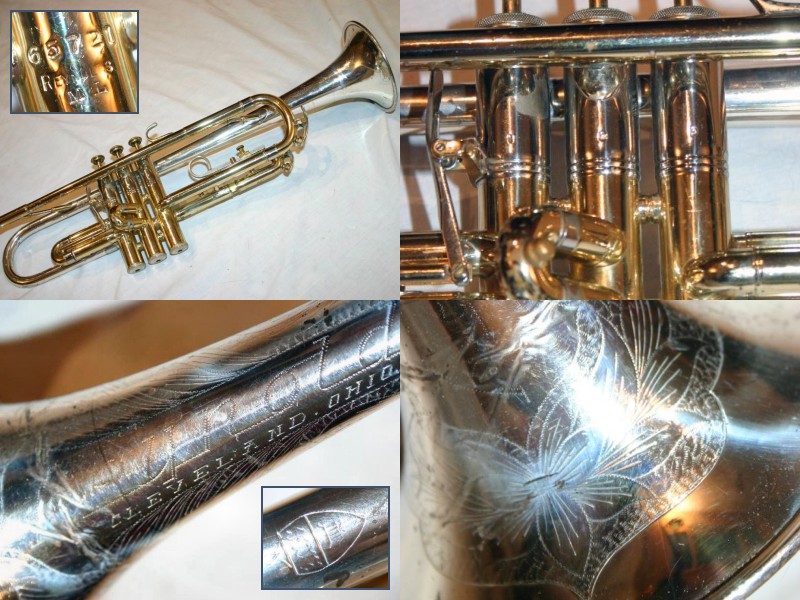
Model TU-??
Previously Model 52; Reynolds Professional B♭ trumpet with first-valve slide trigger
Bore: .458"
Bell: 4-5/8" sterling silver with deluxe hand-burnished gold inlaid engraving
Materials: brass
Finish: polished brass with clear lacquer finish
1971-1973
Reynolds (Fullerton, Calif.)
In 1970-71, Reynolds fully merged production lines with Olds in Fullerton. In most cases, a horn would come off the production line and become either a Reynolds- or Olds-branded instrument based on detailing and finish. The late-model Professional trumpet was made at the Olds plant in Fullerton between 1971/72 and 1973 and was then replaced by the Professional ERA trumpet in 1974.
Model TU-38
Professional B♭ trumpet
Bore: TBD
Bell: TBD brass
Materials: brass with nickel silver upper valve casings (balusters) and valve slide tubes
Tuning Aids: first-valve slide saddle hook; third-valve ring and stop
Finish: polished brass with baked epoxy
The purpose of this website is to preserve the history of the F. A. Reynolds Company and the distinctive qualities of its brass instruments. Contempora Corner and contemporacorner.com are not related or associated in any way to the former or current F.A. Reynolds Company.
Copyright © 2004-2025 ElShaddai Edwards. All Rights Reserved. Terms of Use.